


Calculations
Strength and calculations
Threaded rod strength
Labelling of steel screws
The requirements for the labelling of steel screws are given in the standard ISO 898-1: 2013 ”Fasteners of carbon and alloy steels”. The labelling system for steel screws is indicated by two digits e.g. 8.8.
The first digit indicates 1/100 of the nominal breaking point in N/mm2. In this case 8 x 100 = 800 N/mm2.
The second figure gives the ratio between the nominal yield and ultimate tensile strength of the screw in tenths. Multiplying the figures for the ultimate tensile strength and yield strength of the screw gives the nominal tensile strength: 800 x 0.8 = 640N/mm.
In addition to the strength figures, the screw should be labelled with the manufacturer's trademark. Sometimes you can also see that the screw's thread system is labelled with an M for metric system. Labelling of the thread system is not mandatory.
Designation system for strength
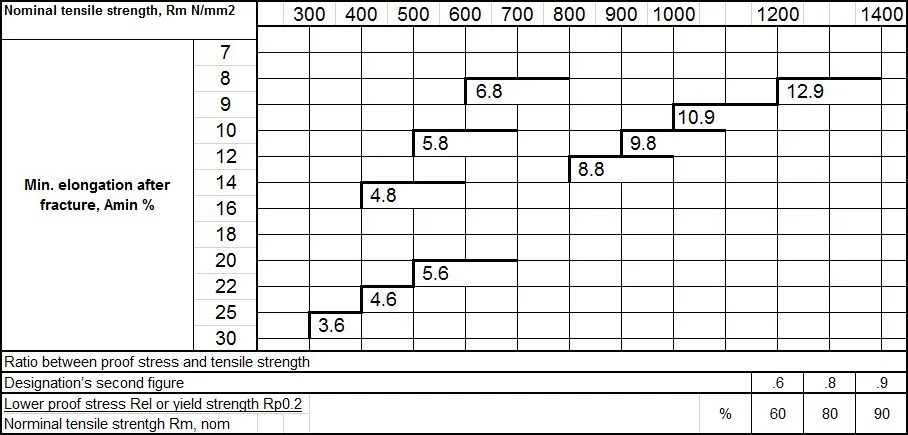
The designation system for strength classes of screws and studs is shown in Table 1. The sketch gives values for nominal ultimate strength Rm in Newtons per square millimetre, while the ordinate gives values for elongation at break A min in per cent.
The strength consists of two numbers
- The first number indicates 1/100 of the nominal tensile strength in N/mm2.
- The second number indicates 10 times the ratio of the lower yield strength ReL (or elongation limit Rp 0,2) to the nominal ultimate strength Rm.
Multiplying the two numbers gives 1/10 of the yield strength in Newtons per square millimetre. Lower yield strength ReL (or elongation limit Rp 0,2) and minimum breaking strength Rm are equal to or greater than the nominal values.
Remarks
Although a large number of strength classes are specified in this part of ISO 898, this does not mean that all classes are suitable for all products. Further information regarding the application of the specific strength classes is given in the respective product standards.
For non-standardised products, it is advisable to follow as closely as possible the choice already made for similar standardised products.
Source ISO 898.
Strength (breaking load and yield strength) of metric coarse threads
Tensile and minimum breaking strength in kN per property class
| Rough thread | Division (mm) | Nominal voltage area mm² | Yield strength Rp0.2 N/mm² | Min. breaking force (As * Rm) N | ||||
|---|---|---|---|---|---|---|---|---|
| 8.8 | 10.9 | 12.9 | 8.8 | 10.9 | 12.9 | |||
| M16 | 2 | 157 | 100 | 141 | 170 | 125 | 163 | 192 |
| M18 | 2,5 | 192 | 123 | 173 | 207 | 159 | 200 | 234 |
| M20 | 2,5 | 245 | 157 | 220 | 265 | 203 | 255 | 299 |
| M22 | 2,5 | 303 | 194 | 273 | 327 | 252 | 315 | 370 |
| M24 | 3 | 353 | 226 | 318 | 381 | 293 | 367 | 431 |
| M27 | 3 | 459 | 294 | 413 | 496 | 381 | 477 | 560 |
| M30 | 3,5 | 561 | 359 | 505 | 606 | 466 | 583 | 684 |
| M33 | 3,5 | 694 | 444 | 625 | 750 | 576 | 722 | 847 |
| M36 | 4 | 817 | 523 | 735 | 882 | 678 | 850 | 997 |
| M39 | 4 | 976 | 625 | 878 | 1050 | 810 | 1020 | 1200 |
Simson Hydraulics AB accepts no responsibility for the consequences of any errors in use or in formulae and programmes.
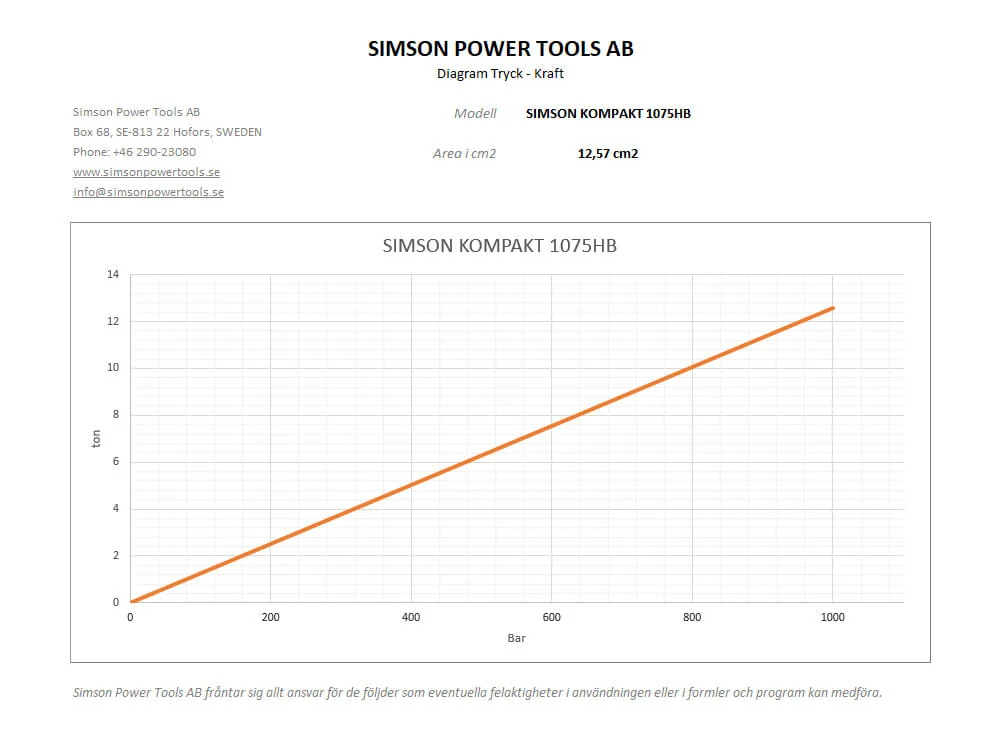
Diagram Pressure - force
Diagram of conversion between pressure (bar) and force (tonnes)
Download the Excel file, enter your cylinder model and area in square centimetres and get a graph to help you convert pressure in bar to force.

Simson Power Tools AB accepts no responsibility for the consequences of any errors in use or in formulas and programmes.
Hydraulic calculations
Area (cm2)
Tryckande
0Dragande
0Differens
0Förhållande
0
Kraft (ton)
Tryckande
0Dragande
0Differens
0
Cylindervolym liter
Tryckande
0Dragande
0Differens
0
Pumpvolym liter
För enkelverkande system
0För dubbelverkande system
0
 Swedish
 English
 German